NGX Dividend Dates Explained: Qualification Date, Ex-Dividend Date and Payment Date
Owning a stock is not enough to get its dividend. You need to own it by the right date, and that date is earlier than most people expect.
This guide explains what each date in a dividend announcement means on the Nigerian Exchange (NGX), which one decides whether you get paid, and walks through a real example from this season, so you never miss a payout.
The basics
- You get the dividend if you are on the company's share register on the qualification date.
- Since 1 June 2026, NGX trades settle one trading day after you buy (T+1). So buy at least one full trading day before the qualification date.
- "Ex-dividend" just means "without the dividend". Anyone who buys from that day on misses this payout.
- The payment date is when the money arrives, anywhere from about a week to a month after the qualification date. You do not have to hold until then.
The dates in plain English
| Date | What it means | What it means for you |
|---|---|---|
| Declaration date | The company announces the dividend and the amount per share. | Keep an eye on it. If you don't own the stock yet, you usually still have time to buy before the qualification date. |
| Qualification date (also called the record date) | The cut-off. Shareholders on the register on this date qualify for the dividend. | Your shares must be on the register by this date, so you buy earlier (see below). |
| Closure of register | A short period, usually starting right after the qualification date, when share transfers are not processed. | Nothing to do. It freezes the list of who gets paid. |
| Ex-dividend date | The first day the shares trade without the dividend attached. | Buy on or after this day and you miss this payout. The price usually drops by about the dividend amount. |
| Payment date | The day the dividend is paid out. | The money arrives in your bank account, with tax already deducted. |
Different calendars label these dates slightly differently, and some show the ex-dividend date and the qualification date on the same day. If you are ever unsure, use the qualification date and work backwards from it.
Why you must buy before the qualification date
When you buy a share on the NGX, it does not land on the company's register the same moment. Until 29 May 2026, trades settled two trading days after the trade date (T+2). From 1 June 2026, the Securities and Exchange Commission (SEC) moved the Nigerian market to T+1, which means a trade now settles on the next trading day.
If you buy on the qualification date itself, your shares settle the day after, which is too late. You are not on the register in time. To qualify, buy at least one trading day before the qualification date.
Weekends and public holidays do not count as trading days. If the qualification date is a Monday, the last day to buy is the Friday before.
A real example: GTCO's ₦1 interim dividend
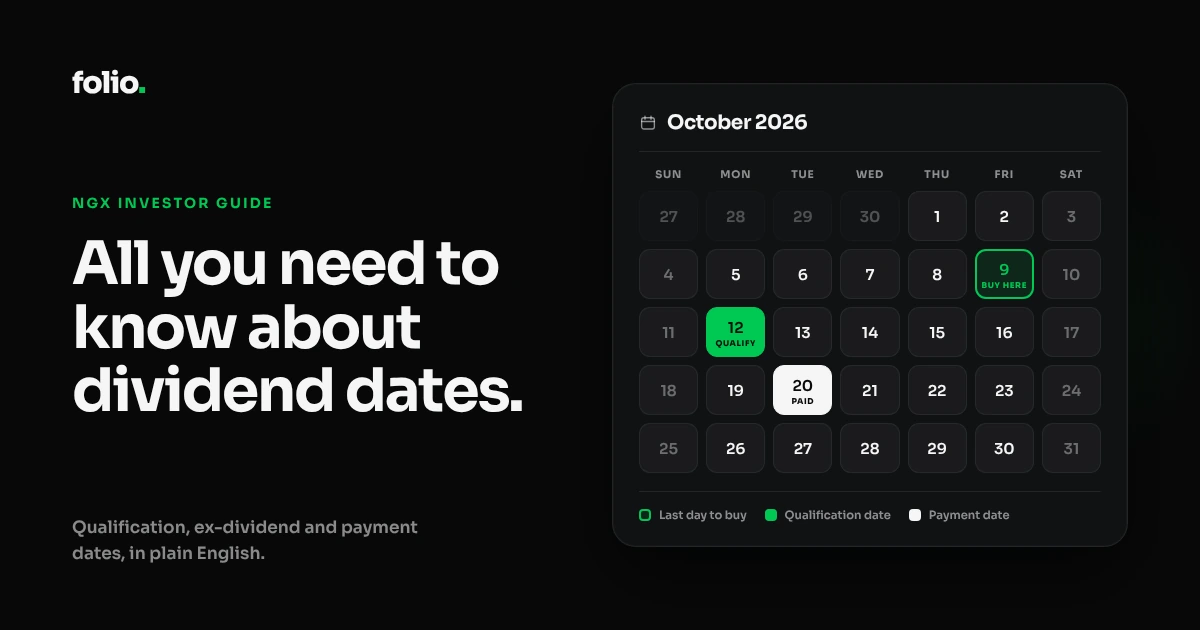
Guaranty Trust Holding Company (GTCO) announced an interim dividend of ₦1.00 per share this season. Its qualification date was Monday 12 October 2026 and payment is on Tuesday 20 October 2026, according to Nairametrics' report on the October dividend dates.
Here is how the dates work out:
- Last day to buy and still qualify: Friday 9 October 2026
- Qualification date: Monday 12 October 2026
- Payment date: Tuesday 20 October 2026
An investor who bought on the Friday and held 121 shares receives 121 × ₦1.00 = ₦121.00 before tax. An investor who bought on the Monday itself gets nothing from this dividend.
What you actually receive
Nigerian dividends are paid after withholding tax. The standard rate is 10%, deducted at source before the money reaches you, and for most individual investors it is treated as a final tax, so you do not owe more on that dividend.
On the GTCO example, ₦121.00 before tax, less 10% (₦12.10), leaves ₦108.90 in your account.
Investors based in countries that have a tax treaty with Nigeria may be able to claim a lower rate, often quoted as 7.5%, but they usually have to prove tax residency. This is general information, not tax advice. Confirm your own position with a tax professional.
Where to find the dates
Companies publish dividend notices on the NGX website as corporate disclosures, and financial news sites run monthly dividend calendars. Look for four things in any notice: the dividend per share, the qualification date, the closure of register dates and the payment date. Many notices also name the registrar that pays the dividend (GTCO's is DataMax Registrars).
You can also let Folio do the watching. Add the stocks you own and Folio emails you a few days before a dividend deadline, so you do not have to check calendars yourself.
Mistakes that cost people dividends
1.Buying on the qualification date. Under T+1 the trade settles the next day, after the register is set. Buy at least one trading day earlier.
2.Selling too early. Wait until the qualification date has passed before you sell. A sale made just before it can settle in time to take you off the register.
3.Expecting the share price to hold. After the qualification date the price usually falls by roughly the dividend amount. When Zenith Bank's ₦8.75 dividend went ex-dividend in April 2026, the NGX marked its price down from ₦135.90 to ₦127.15. A dividend moves value from the share price into your bank account. It is not free money.
4.Not having your bank details on the register. Dividends are paid electronically. If the registrar does not have your bank details, your payment can be delayed or sit as an unclaimed dividend. Ask your broker whether your e-dividend details are up to date.
What to do next
Pick one stock you own, look up its next qualification date and write down the last day to buy. If you would rather not track it by hand, add your holdings to Folio and we will email you before the date.
Frequently asked questions
Do I get the dividend if I buy on the qualification date?
No. Trades settle one trading day after the purchase (T+1), so a purchase on the qualification date misses the register. Buy at least one trading day before.
Do I have to keep the shares until the payment date?
No. You need to be on the register on the qualification date. Once it has passed, you can sell and the payout is still yours.
Why does the share price drop after the qualification date?
The company is about to pay out cash, so each share is worth roughly that much less. The NGX marks the price down by about the dividend amount, as in the Zenith example above.
Is the dividend I receive the full amount declared?
No. Withholding tax of 10% is deducted at source. On ₦1.00 per share you receive ₦0.90 per share.
This article is for information only and is not financial or tax advice. Dates, rates and rules can change. Confirm details with the company's announcement, your stockbroker or a licensed adviser.